Quote

"There is nothing to writing. All you do is sit down at a typewriter and bleed." -Ernest Hemingway

Showing posts with label writing. Show all posts

Saturday, November 28, 2015

In the Head and Being thankful

Image from Wikimedia Commons
Lately, I have been second-guessing myself as a teacher. Each semester starts out with a lot joy and optimism of what is ahead, and then towards the end, it becomes more like a dark night of the soul kind of moment. I think this has to do with the part-time, adjunct status I have at each of the schools I teach at. There is a lot of insecurity, questions, variables, and un-answerables that I have to get comfortable with. Even though I think I do a good job with the classes I teach (freshman comp), I never know how long I will be teaching. I never know if this semester will be the semester I don't get called back to teach.

Now luckily, here at the end of November, I do know the answer to that question, as I have been asked back to teach at both schools. But, there were several weeks there where I was just sitting with that uncertainty. Not know if there was going to be enough money in my future to pay the bills. That feeling washes over you, it absorbs you, and ends up making you feel insecure about your yourself, your life, and your abilities. This really is the ugly side of adjunct teaching. Sure, it's cheaper for the school to hire adjuncts, without a doubt, but this assembly-line system we've created has reduced many talented teachers to second class citizens. I find myself among them. 

Bitching comes easy for me, so I'll try to limit myself here. I tend to default to the "glass half empty" philosophy, therefore I constantly have to remind myself of the good that exists in the world, too. Gratitude and positive thinking usually get me back on firmer footing. I am happy to have a job. I am happy to get to teach/talk about a subject I love:  Writing. I know not everyone has this luxury, or opportunity. 

In the world that has everything, with people constantly in search of more, more, more (Moah, moah, moah, if you're Billy Idol), gratitude is the hardest position to maintain. This is especially evident at Thanksgiving, when shortly after the turkey is carved many head out to the stores to fill their carts with the more, more, more. These folks have a difficult time being grateful with what they have, and who they are sharing it with. Gratitude is hard for me, too, but I work at it. 

Before Thanksgiving I was stuck in my head, thinking about my own worries and problems to deal with. Some problems real, some imagined. Thankfully (see, gratitude is happening as we speak), I got out of my own head space long enough to enjoy the damn holiday. It was a good time that I shared with my girlfriend and her family (my folks were away in Tennessee).

My girlfriend's grandmother was here, too. Alzheimer's has taken almost all her memory. She didn't recognize anyone, so she had to meet folks she had known for years like it was the first time again. Very sad, indeed. Her memories were now living in those around her. We were remembering for her. Sitting at the table, eating her meal in a strange place with strangers all around, I wondered what she must have been thankful for? Was she thankful that after all was lost and forgotten within herself that she had other around her who loved, cared, and remembered her? 

I can't say for sure, but I would say she was grateful. It is good to be remembered, especially when you don't remember yourself. Again, the brain's ability to think and perceive is something I am thankful for on a daily basis. There is nothing about these processes that is guaranteed and they don't last forever.

Saturday, October 3, 2015

Musings from the fall semester

The first leg of the fall semester is nearly over and it is almost fall break. For the first eight weeks I have been teaching a developmental writing course and English 111 - a basic college composition course. My developmental writing course will end in about a week, and for the most part I think this will be a largely successful group. I don't see too many falling through the cracks. The first part of the semester has been slightly busy (at least for adjunct standards), but I'm set to be even busier the next eight weeks, as I will be picking up a couple more classes at another relatively nearby community college. 

I have been inducted into the traveling/commuting "highway warriors" and nomadic teachers brigade. My car is sad that she is losing her youthful look and is aging. It's gonna be hell on wheels for the next couple of months heading into Christmas, but I know it's going to be good experience for me, a young teacher hoping to launch some kind of career - sooner rather than later. It will be nice to compare the two schools where I work and see how they do things differently. Honestly, I'm just trying to branch out and make more connections in the hopes that something will lead to a full-time job - it is the fairytale wish of most adjuncts, who feel underpaid and under appreciated at times. I'm trying to stay humble and level-headed about everything. Glass half-empty is my default setting, but I do a good job of forcing myself to stay positive:  something will come along I tell myself. 

Lately, I've been doing an okay job of journaling, although my blogging has definitely lagged behind. Like everything else, it's difficult to find balance at times. Since the beginning of the semester I have thrown myself into my teaching. Also, I've had to track down papers and sign stuff for the college I am set to work for part-time. Of course, I had time left over, I could have been writing - but other distractions quickly filled the void. I think that is part of the problem of today's world, it's so damn entertaining and distracting. Between TV, movies, games, music, and the various platforms and mediums we are being assaulted by those items, it's hard to find a quiet time to think and write

I see students having these same issues in focus and attention. They often have a hard time prioritizing their time and distractions. I see this in classrooms I teach where students have computers sitting right in front of them. The urge/pull to get onto the closest distraction is strong, even though I tell them they will get so much more out of actually listening to my lecture and paying attention. I think because of the multitude of distractions, it may actually be more difficult to be a student today than in times past. Today's students have a much tougher time zoning in on what they should be doing, because there are so many more entertaining options they could be doing. 

To counteract the above in some small way, I have started showing David Foster Wallace's "This is Water" speech. In the speech he touches on things like attention, focus, and how to think critically amid today's many distractions. These are all traits that freshmen college students desperately need, not only in the writing courses I teach, but in their college experience in general. And, of course, the speech itself becomes its own exercise in attention building, as Wallace's mind is sometimes tricky to follow - he was for many a genius, and we are but mere mortals. Ultimately, I think its a good exercise in getting students to think deeply from the outset of the course.   

Thursday, June 18, 2015

When do you feel like a writer?

Image from Wikipedia Creative Commons
Some days, I'm not sure I'm much of a writer. My productivity is low lately. Putting word after word is difficult for me. The process of writing is not an easy one. At work, teaching at a local community college, I spend my days talking about how to make the writing process easier, but lets face it, it never truly becomes easy. At least in my case, once I start writing, the thoughts begin to flow. But, that initial sitting down to write is difficult. In today's world, there are so many things vying for attention - all the myriad distractions. So many things exist to divert our attention, while writing challenges us to channel our attention and thoughts. On a daily basis, I make excuses to stay in the world of diversion, mostly because it is easier.

I started this year hoping to write more in my spare time. I have been successful, but only by degrees. I thought I would spend more time writing short stories to fill my time, but have only had starts and stops in that regard. Where I have had some success is in finding time to gather my thoughts/feelings and chronicle my days in journal form. For me, journaling helps to empty my mind, clear a sometimes heavy heart - it's a catharsis more than anything. I don't write for long, and I don't write everyday, but when the spirit moves (perhaps, few times weekly), I try to put pen to page, and sort through the issues of my day.

Feeling like a writer is something that most writers struggle with. Some love the old platitude, "If you write, then you're a writer," but we know the heart of the matter is much more complex. As a younger man (college days and before), I desperately clung to the idea of myself as a writer. I was a writer. Or at any rate, I would one day be a writer. I could see introducing myself at dinner parties, perhaps with an air of pretension in my voice, "I am a writer." However, as I have matured, I know that the identity of writer is a heavy mantle to assume.

Even when I wrote for two Podunk weekly newspapers and book reviews for a small metro daily, I still didn't feel like a writer. A check came with my name on it. I was paid for my writing. By all standards, this should have been the moment I declared myself a writer. And, yet, that moment never came. For too many writers, I think writing is there to fill some void in the self. You may not even know you are filling it. But it is there. It needs to be filled. It could be the thirst for attention, notoriety , or the father-son projects you never had, but you need it for a reason.

As I have grown up, and matured, I realize that writing is less about how you associate with the identity, and more about how you associate with the process. Writing is an important process to me. There is a hunger to take part in that process. If that makes me a writer, that's all well and good, but assuming that identity and bolstering my sense of self is not what keeps me up at night. Maybe the platitude should be changed to, "When you write, you're writing." Break it down into almost Cartesian terms, and put the focus on the process.

I know I'm just riffing on an idea here. I know I'm not the first to go woe-is-me on writer's block. Folks probably suffered from writer's block even when they were writing on blocks. I'm just trying to make sense of my own little corner of the world, and writing this helped.

Saturday, March 21, 2015

Home repairs, teaching, and more!

I must apologize for not posting on here more often (especially now that I know I have at least one reader, hah!). The second week of March, I was on a one-week spring break from the community college where I work. For the most part, my break was restorative, rejuvenating. But my week of relaxation faded into some hellish bathroom repairs on my girlfriend's grandfather's nearly 100-year old house, where we live now.

What we thought would be a simple toilet installation at the start of the week, eventually brought me from the floor joists and bowels of the house, repairs to the subfloor, and all the way back up to the new vinyl floor we put down. In the process, the learned I am not much of a handy man, so over the course of the week, I learned how to use like every power tool. Ever. The repairs would not have even been possible without the gracious support of my neighbor and friend, Pat, and my housemate's dad, both of who worked tirelessly to help me.

All the while, I was starting to teach my second 8-week English 101 course. I had good materials ready to go, I was more than ready to get back to teaching, but for most of the week, I just felt like I was hanging on, and trying to survive the week. At the same time, my cc-sponsored online class on how to teach online is winding down (just a couple of weeks to go), and I had homework in there during the week. That is why I just tied a knot at the end of my rope and just held on. It wasn't easy to be working on home repairs until midnight one day, and then be back up at 7:30 a.m. the next morning to get to work to do some planning and finally teach my class.

I'm not making excuses, but needless to say, all of the aforementioned left me feeling drained creatively, not to mention physically. Ergo, no blog posts.

My stint in carpentry/plumbing this past week further instilled my deep respect for anyone that does manual labor on a daily basis. You guys/gals are fighting the good fight. You are the doers and makers. Most days, I am lucky to get by on simply using my brain to make my living. My brain is still my strongest muscle, so teaching/learning suits me. I know this is NOT mining work, construction, etc. I know more about the Mines of Moria, than I do about any actual mines (Tolkien reference)!

I'll hope for now that my home repairs will give me a rest for awhile, so I can get back to following my creative passions and pursuits, which includes posting more here.


Tuesday, February 24, 2015

Reaching Enlightenment in Kipling's "Kim"

Penguin Classics Edition of Kipling's Kim
Image from Amazon.com
I recently muscled my way through a classic that alluded me through graduate school.

When I first read, rather tried to read, Rudyard Kipling's Kim in graduate school I felt I had met my match. Although this was the book that was widely considered to be Kipling's masterpiece I couldn't believe it at the time.

I found that Kipling's book of high adventure during the height of British power in India to be a dull, prodding affair, especially in the earlier chapters. I found myself in the same position as Kim, the young title character, and his lama (read: not llama), looking for enlightenment in some way.

When I was in grad school, I read enough criticism, did enough background research, and read enough of the book to write a decent response essay highlighting the main ideas and themes behind the book. I managed my way through my class discussion. And yet, after all this, I knew I had not conquered Kipling's book.

Part of what turned me off of Kipling's book initially was the fact that the author has been trailed in history by a somewhat morally reprehensible past, that is inescapable, but not always helpful in judging a work of literature, initially. My only familiarity with Kipling in grad school came from having earlier read his poem, "The White Man's Burden," which smacked of all kinds of racism, cultural dominance, and Social Darwinism. Not exactly admirable traits in a writer.

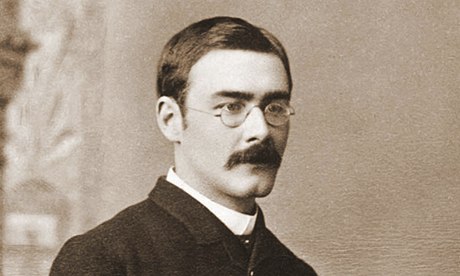
Kipling, a writer not without edges.
Image from theguardian.com
And, yet, through it all, Kipling remains a towering giant of English literature.  Why? The answer to that question alluded me until a couple of nights ago when I finished Kim. Personal, social, and moral shortcomings aside, Kipling's writing has an endearing, enduring quality, which remains largely untarnished by time and criticism.

Edward Said, author of Orientalism, had a scathing view of Kipling's Kim at the end of the book. In Said essay, he highlights all the ills of British Colonialism in India. Boiled down in essence, Said posits the British citizens believed they were destined and entitled to rule, and as such, believed they were better than all races, including Indians.

This was the world in which Kipling penned Kim, the story of a young, orphaned British boy who goes on a quest with a lama to find a sacred river in the northern reaches of India. The lama believes that finding the river is essential in reaching his enlightenment. The boy simply wants adventure. At times Kim believes the old man's quest to find the sacred river a little crazy, but follows nonetheless, partly born out of a sense of deep compassion and respect for the withered spiritualist. It is here that Kipling's powers as a writer shine through.

Apart from the undertones of racism (on all sides) that run through the book, Kipling's message, story, quest, etc. has a lot heart and remains timeless. That timeless nature is evident is the book, where the lama tells the boy that life is like a "Wheel" that goes around and around. Enlightenment releases you from the wheel, but only for those wise enough to find it. A late scene in the book has Kim coming face to face with a woman who lost her son, an irony not lost on the reader, since the boy lost his parents. This is a great example of the wheel coming to play in the story, as both philosophy and motif. Pain, desire, struggles, loss, and happiness are all part of the "Wheel" and are part of life.

At the books end, the two find the river, and the lama beckons Kim to join him in his enlightenment. The book ends in a somewhat obscure, open-ended manner. Kim doesn't really believe in the concept of enlightenment, but the lama says, "Come!" and join him, as if enlightenment is his for the taking. He need only walk the path.

By the novel's end, I'm not sure if I fully reached enlightenment, but I definitely feel I have a deeper appreciation and understanding for Kipling's work.

Life Beyond the Red Pen


Image from Clipartpanda.com
Grading is not my favorite part about teaching (is it anyone's?). I really enjoy engaging students with new material, throwing ideas at them, and watching the lightbulbs come on. Seeing a student's improvement in writing over the course of a semester is very fulfilling.

But, every few weeks or so, I have to put on my other "cap" as grader. I guess some teachers relish getting out the red pens (slowly going the way of the buffalo in today's technology-driven culture, really I use Turnitin.com) and marking up student papers with gusto. I do not relish the task, but I do understand the importance of the task.

Giving a grade in writing is no small task. Where in math there may only be one answer, and that eases the burden of grading, writing is totally different. It's often not easy to weight out a students idea, or essay, and say how it measures up. Case in point, recently I received a well-written essay, but it totally ignored the prompt and the style of essay we were examining at the time. Here, clearly the student missed the mark of the assignment, and yet, good quality writing prevailed. Unfortunately, I had to dock the student several points for this.

Some might be comfortable in this role of grand arbiter of taste, judgment, and the RED PEN, but lets face it, it's not an easy role.

Over the course of a semester, as a teacher of college composition, you face lots of these little judgments along the way. Decisions and decisions. Rinse, wash, repeat. With this in mind, it's common to start second guessing yourself in the grading process. Did I judge this student's work too harshly? Or, Was I not harsh enough? 

See, writing is not an exact science. It is not something that teachers can look at in a completely objective manner. It is a craft, can be an art, and at the end of the day, it remains largely subjective. 

Which brings us back full circle to the sometimes painful process of grading. Sure, with my experience in writing, I have learned to recognize the full spectrum of bland, good, and great writing. Along with plagiarism, poor citations, and other ills that come with the territory. But, when it comes to grading students responses, stamping a tough grade on a student's paper sometimes feels like a chore. A poor grade can challenge a student to hone his or her craft, rise to the occasion on the next assignment, etc., but it can also be the death knell of the student's ambition to write, especially for students that may lack the confidence to continue through a setback.

I think more times than not, I err on the side being a little soft in my grading. Some seasoned, hardened teachers might see this as a setback, but I try to be encouraging and supportive in my feedback to students' papers. They need the support to continue on in the craft that really has no end point. One will be honing his or her writing skills throughout life. They need to be shown that it is possible for them to improve. And, students need feedback to be shown how to get there - this comes by the measured hand of constructive criticism. Too much, and the student shuts down. Just enough, and well that is where you begin to see students stick with the process and improve.

Friday, February 20, 2015

Obligatory first post post

I'm creating this blog in an attempt to make good on one of my New Year's resolutions, and that is to write more. For the past two years, my dedication to my own writing has fallen by the wayside. A couple of years ago, I was hired to work as a sports reporter for a small-town community newspaper. A lot of cold nights and cold dinners left me with little desire to write in the evenings, after filing my late-night stories/website updates. I don't even remember when my last journal entry was. 

Now, for the past year or so I have been teaching and tutoring writing (English) at a local community college. While I find that much more fulfilling than my pervious position as a sports reporter (heck, I didn't like sports), I haven't found much time to write. But, that doesn't mean that I didn't have time to write. It just means that I have made a lot of really good excuses for not writing:  read that as procrastination. That's not something I'm proud of, but it is the truth. 

The better part of the past two years I've spent vegging out online - reading blogs, instead of creating. Why? Well, for starters, it's way easier to absorb and digest, than to think and create. And, that's where I've pretty much been stuck...for two years. 

Sure, I had I few starts and stops on some blogs in the past several months, but for the most part those have tended to be more on the stop side of the spectrum. It's not something I'm proud of, but I'm being frank here. 

At this point, I'm not sure what exactly this blog will be, but I'm envisioning it as some kind of catch all for my wayward and passing thoughts through the week. I have really awesome ideas for my writing, teaching, etc. through the week that fade in and out of my consciousness without ever making it into the world of reality that we all share. This blog is going to challenge me to at least catch some of those ideas to make use of at a later date. I don't consider myself to be a terribly creative person, but I think everyone is blessed with some creativity in one way or another. What we do with that creativity is up to us.